

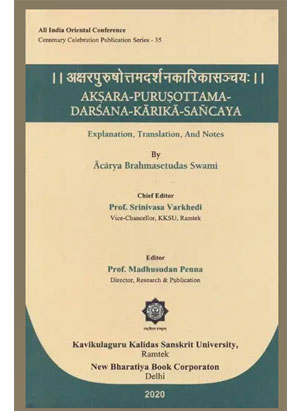
Akṣara-Puruṣōttama-Darśana-Kārikā-San̄caya (Explanation, Translation and Notes)
Akṣara-Puruṣōttama-Darśana-Kārikā-Saṅcaya is an accessible introduction to the foundational teachings of the Akṣara-Puruṣōttama Darśana through selected verses drawn from the Svāminārāyaṇa-siddhānta-sudhā, the tradition’s celebrated vāda-grantha authored by Bhadreshdas Swami. Conceived as a pedagogical work for students, scholars, and newcomers alike, the volume seeks to make the sophisticated philosophical discourse of the Darśana approachable without compromising its intellectual depth. The work presents key kārikās together with transliteration, padaccheda, grammatical analysis, anvaya charts, English translation, and explanatory notes, enabling readers to engage directly with the original Sanskrit while also benefiting from structured guidance. In doing so, it opens a pathway into one of the most recent and influential developments within the Vedānta tradition.
Organized into nine thematic chapters, or dhārās, corresponding to those of the Svāminārāyaṇa-siddhānta-sudhā, the text systematically explores the central philosophical categories of the Akṣara-Puruṣottama Darśana. The work is further framed by the “Siddhānta-patra” of Pramukh Swami Maharaj, providing readers with a concise overview of the tradition’s core principles before entering into the verses themselves. Designed with both traditional and modern audiences in mind, the book serves as a guided entry into the philosophical, theological, and literary world of the Akṣara-Puruṣottama Darśana and its broader Vedāntic context.
This work was published as part of the prestigious AIOC Centenary Publication Series, which commemorated the 100th year of the All India Oriental Conference. The volume appeared in conjunction with the historic 50th session of the conference, hosted by Kavikulaguru Kalidas Sanskrit University, Ramtek. By being included in this series, the text forms part of a broader scholarly initiative to preserve, study, and disseminate important works of Sanskrit thought, while also encouraging future generations of students and researchers to engage meaningfully with India’s intellectual traditions.